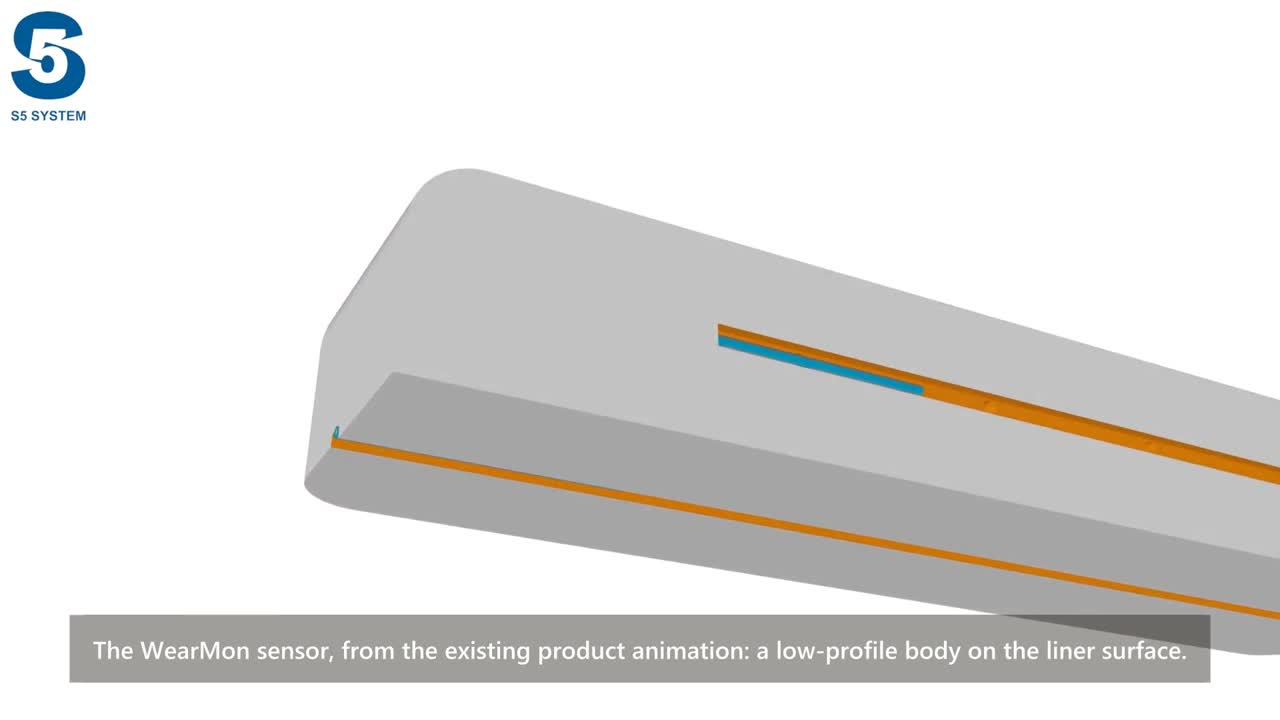
What happens today
Thickness is checked during planned shutdowns, and condition between shutdowns is inferred from throughput, sound and operator experience. A wash-through is discovered when slurry appears outside the shell.
Wear-liner telemetry
WearMon measures wear-liner thickness continuously on rotary scrubbers and mills, so relining is planned from a measured trend instead of guessed between shutdowns. The sensor is fitted through a prepared shell fitting and reports while the plant is running.
A scrubber liner is consumed by abrasive slurry every hour the plant runs, but the only reliable thickness figure most sites hold is the one taken with the shell open. Between shutdowns the liner is either replaced early to stay safe, or run past the point where its remaining thickness is actually known. Both choices are expensive, and neither of them is a measurement.
Thickness is checked during planned shutdowns, and condition between shutdowns is inferred from throughput, sound and operator experience. A wash-through is discovered when slurry appears outside the shell.
WearMon reports thickness on a schedule against the same liner zone, so consumption per tonne is visible between shutdowns and the reline date is set from a measured rate rather than a fixed calendar interval.
A probe at the shell, a radio node beside it, and a record that turns single readings into a wear rate.
A thickness sensor fitted through a threaded shell fitting and sealed with Loctite 243 and a serrated star washer, so sustained shell vibration cannot walk it loose.
A battery-powered node that reads the probe and sends the value over LoRaWAN or NB-IoT, so no cable has to survive the running shell and no slip ring is needed.
Every reading is timestamped against its liner zone, which is what converts scattered millimetres into a consumption rate a planner can defend in a shutdown meeting.
WearMon ships as a sensor and radio node per monitored liner zone, with a gateway option for sites without LoRaWAN coverage and the record store that holds the wear trend.
WearMon sensors were commercially procured by Thejo Australia and installed on three heavy rotating scrubbers at Fortescue's Solomon Hub in the Pilbara and at a gold processing plant in Kalgoorlie. The record below is a sample, not a reproduction of a customer's data.
Sample record. Values are illustrative and are not customer data.
The moat is the fitted-sensor history. A wear rate can only be quoted from readings taken at the same zone over time, and that series is what makes a reline date defensible to a planner.
WearMon measures thickness at the zones where a probe is fitted. It does not scan a whole shell and cannot resolve a wear pattern between two probe locations. It is a planning instrument, not a protective device: it does not stop a wash-through by itself, because that still depends on the plant acting on the trend. Thickness behind ceramic or polyurethane tiles is only reported where a probe has been integrated into the tile. The kit is built to order, and supply timing is confirmed in the written quotation.
WearMon measures and reports what its sensors see. That is monitoring, not a compliance or safety certification: the log is evidence of what the equipment recorded, and nothing on this page, in the quotation or on the invoice certifies your site, your process or your equipment against any standard.
WearMon, on film. The video plays from YouTube only when you press play; until then this page requests nothing from anyone else.
Telemetry shown is illustrative — default values, not a measured test. Prototype plus existing product animation. Watch on YouTube (opens youtube.com).
One product page S5 owns. The listed price is A$4,900 plus GST and includes the first 3 years of the subscription. Nothing is sold directly from this page: the listed price is recorded through a written quotation, and the quotation states the lead time, the freight and the payment terms for your site.
| Piece | What happens | Status |
|---|---|---|
| Quotation | A written quotation is issued for this page and the configuration shown | Issued on request |
| Buy now | Opens the quotation page: the listed price is recorded against a written quotation, no order, no payment | A$4,900 plus GST held |
| Lead time and freight | Stated in the written quotation for your site | Confirmed in the quotation |
| Commercial quote | A quotation reference is issued for this page and configuration | Instant, same page |
| Subscription, from year 4 | The first 3 years are inside the listed price | Not charged today |
One email address and your configuration, and the quotation for this WearMon build is issued against this page. No account, no sales call required.
Direct answers to the questions buyers, installers and AI search tools ask about WearMon.
WearMon measures the thickness of the wear liner at a fixed point on the shell. The probe is fitted through the shell into the liner zone, and each reading is a direct thickness value in millimetres rather than an inference from vibration or power draw. Because the point does not move between readings, the difference between two values is real liner consumption.
The probe is fitted through a prepared threaded fitting in the shell, sealed with Loctite 243 and a serrated star washer. The star washer resists the loosening that continuous shell vibration would otherwise cause, and the thread seal keeps slurry on the inside. Fitting is done during a reline, when the shell is already open and the liner face is accessible.
Yes. The probe reads continuously and the radio node sends over LoRaWAN or NB-IoT, so no cable has to survive a rotating shell. That is the difference between a thickness trend and a single shutdown measurement: readings keep arriving while the mill is in production, which is exactly the period during which the liner is being consumed.
A missing reading is treated as missing data, not as a thin-liner pass. The record shows the gap, and the site can see how long the zone has been dark. A probe that has failed or a node whose battery has sagged is an open maintenance job, and the wear trend for that zone is frozen rather than extrapolated through the gap.
No. The shutdown inspection still sees the whole shell, and WearMon sees the fitted points between shutdowns. The practical change is that the shutdown inspection confirms what the trend already predicted, instead of being the only moment when liner thickness is known at all. Sites that keep both get a complete picture and a defensible reline date.
WearMon is aimed at the zones that dominate reline decisions: scrubber shell liners, discharge ends, launder and transfer chute wear plates, and cyclone feed launders. Where a site uses ceramic or polyurethane tiles, the probe is integrated into the tile so thickness is read through the consumable. Zones without a fitted probe are not measured, and the page says so rather than implying full-shell coverage.
The trend gives consumption in millimetres per thousand tonnes, and the liner drawing gives the minimum safe thickness. Dividing the remaining thickness by the measured rate gives the days left at the current duty. If throughput or ore abrasive index changes, the rate changes and the date moves with it, which is what a fixed calendar interval cannot do.
The listed price covers the sensor and radio node per monitored zone together with the first 3 years of the subscription. A gateway is quoted separately where the site has no LoRaWAN coverage. Nothing is ordered and nothing is charged today; Buy now records the listed price against a written quotation.
No. WearMon is a condition-monitoring instrument that produces thickness evidence for planning, and it is not certified as a safety device or as part of a safety-instrumented function. Nothing on this page should be read as a protective function that prevents shell wash-through. The plant's own inspection and operating procedures remain the control that keeps people and equipment safe.
WearMon is A$4,900 as listed, and that figure already includes the first 3 years of the subscription. From year 4 the subscription continues at the published monthly rate. The price covers wearMon ships as a sensor and radio node per monitored liner zone, with a gateway option for sites without LoRaWAN coverage and the record store that holds the wear trend.
WearMon ships as a kit: WearMon ships as a sensor and radio node per monitored liner zone, with a gateway option for sites without LoRaWAN coverage and the record store that holds the wear trend. No S5-designed radio enclosure is required, because the site gateway is a finished product bought off the shelf. Installation is a guided self-install, and the site needs mains power or the supplied battery option at the gateway location.
WearMon is quoted against a written commercial quotation. The quotation states the configuration, the price, the lead time and the freight for your site, and sets out the ordering, invoicing and delivery terms before anything is committed.
Use the “Get instant commercial quote” form on this page, which needs only your email address and your configuration choice. The store records the request against the wearmon subdomain and issues a quotation reference, so the enquiry is traceable rather than lost in a mailbox. You receive the quotation for the configuration and price shown. Nothing is ordered and nothing is charged until you accept it; use the Buy now button to record that price against your quotation.
A WearMon failure is recorded as evidence and handed to the operator, not silently retried. The record keeps the measured values, the time of the event and the limit that was crossed, and the response is a documented action by your team, not an automatic decision by the device. A missing reading is treated as a missing data point, not as a pass.
Service desk, S5 System Pty Ltd. A support engineer answers, usually within one business hour.
WAWhatsAppMessage or call +61 468 728 893 TGTelegramCall or chat +61 468 728 893 ☎Phone+61 468 728 893Talk to an S5 engineer about whether WearMon fits your site. Pick a time that suits you. The call is free and there is no obligation.
Questions on fit, price, setup or commissioning? A support engineer replies to every enquiry.
One email a month: what actually failed, what the sensors caught, and what it cost. No product pitches.